Showing posts with label Nietzsche. Show all posts

Monday, February 19, 2007

God is Dead... And We Have Killed Him

The Madman. Have you ever heard of the madman who on a bright morning lighted a lantern and ran to the market-place calling out unceasingly: "I seek God! I seek God!" As there were many people standing about who did not believe in God, he caused a great deal of amusement. Why? is he lost? said one. Has he strayed away like a child? said another. Or does he keep himself hidden? Is he afraid of us? Has he taken a sea voyage? Has he emigrated? - the people cried out laughingly, all in a hubbub.

The insane man jumped into their midst and transfixed them with his glances. "Where is God gone?" he called out. "I mean to tell you! We have killed him, you and I! We are all his murderers! But how have we done it? How were we able to drink up the sea? Who gave us the sponge to wipe away the whole horizon? What did we do when we loosened this earth from its sun? Whither does it now move? Whither do we move? Away from all suns? Do we not dash on unceasingly? Backwards, sideways, forwards, in all directions? Is there still an above and below? Do we not stray, as through infinite nothingness? Does not empty space breathe upon us? Has it not become colder? Does not night come on continually, darker and darker? Shall we not have to light lanterns in the morning? Do we not hear the noise of the grave-diggers who are burying God? Do we not smell the divine putrefaction? - for even Gods putrify! God is dead! God remains dead! And we have killed him!

How shall we console ourselves, the most murderous of all murderers? The holiest and the mightiest that the world has hitherto possessed, has bled to death under our knife - who will wipe the blood from us? With what water could we cleanse ourselves? What lustrums, what sacred games shall we have to devise? Is not the magnitude of this deed too great for us? Shall we not ourselves have to become Gods, merely to seem worthy of it? There never was a greater event - and on account of it, all who are born after us belong to a higher history than any history hitherto!" Here the madman was silent and looked again at his hearers; they also were silent and looked at him in surprise.

At last he threw his lantern on the ground, so that it broke in pieces and was extinguished. "I come too early," he then said. "I am not yet at the right time. This prodigious event is still on its way, and is traveling - it has not yet reached men's ears. Lightning and thunder need time, the light of the stars needs time, deeds need time, even after they are done, to be seen and heard. This deed is as yet further from them than the furthest star - and yet they have done it themselves!" It is further stated that the madman made his way into different churches on the same day, and there intoned his Requiem aeternam deo. When led out and called to account, he always gave the reply: "What are these churches now, if they are not the tombs and monuments of God?"

--Friedrich Nietzsche. The Gay Science (1882), section 125

Nietzsche did not mean that God was literally dead. For if that were true then it would've meant that God was alive in the first place. To Nietzsche the belief in God and the social underpinnings that stem from that belief had been replaced by science and rationalism. To Nietzsche we no longer needed a moral code based on religion. Taken one step further, if our morality is not based on religion then it is not based on absolutes. Therefore, morality is relative.

Now, whenever I read Nietzsche's quote I have this tendency to stop right after the statement "God is dead! God remains dead! And we have killed him!" Two things come to mind: morality & religion. I look around and see a world of moral decay. A world where self-interest rules and morality is all relative. It seems as though we are in a spiritual crisis. And when I look at the thought that we have killed God I look to the hearts of men.

How did we get here? The more we think we know the less we really know. We just think that we know everything. And the more knowledge we have, the less wisdom. Knowledge is power and instead of relying on faith we have learned to question everything. Challenge... Question... Rebel... Morality can now be found in shades of gray. There is no black and white, just shades of grey.

Then there is the church. Organized religion is based on traditions and has a tendency not to change with the times. As Marx said, "Religion is the opiate of the masses." How many churches are in a decline? Fewer people are choosing to attend church services. The Bible speaks of fellowship but does it have to be in church on a Sunday morning? Back in the day Jesus went out to the people. He met them where they were at. He even turned water into wine. Now I would like to have that kind of ability.

When I look around society all I see is blindness. I guess the real question is, if God is dead and we have killed him, will he be revived? Or have we turned our back forever?

Sunday, June 11, 2006

Truth: An Absolute or Just Relative?

I know I am deviating at the moment from the debate of equality/diversity and inequality.... but in almost any philosophical debate the question of truth arises.

Truth is definied as:
  1. Conformity to fact or actuality.
  2. A statement proven to be or accepted as true.
  3. Sincerity; integrity.
  4. Fidelity to an original or standard.
    1. Reality; actuality.
    2. often Truth That which is considered to be the supreme reality and to have the ultimate meaning and value of existence.
For centuries truth was seen to be the underpinning of philosophy. Truth was an automtic assumption... It was only with the writings of Kant, Nietzsche, and Marx, among others that this belief has been challenged. Can we automatically assume that truth exists? Is there such a thing as abosulute truth?

If truth is relative does that mean that the debate over equality/diversity is reduced to the political and social arena? Or does it even matter? Do we need some idea of truth as the basis for everything else?

Say there is no such thing as truth. Truth is just a construct and it is all relative. Then what I believe to be true someone else may believe is false. Take the statement "There is inequality in the world today." Is that statement true or false? Depends on whether or not truth is an absolute or is relative. If it's relative then the validity of that statement depends on politics, society, even time. We assume that equality is the ideal but that inequality is unavoidable. Without some absolute standard the reverse could also be true.

Take the statement, "There is no such thing as truth." If you assume that a statement is either true or false then there are two conclusions. 1. It is true and there is no such thing as truth (which would actually make it an absolute truth) or 2. It is false and truth exists. Believers in absolute truth use theis example as a proof that truth is absolute. But... it is possible that this is the only absolute truth. Is there anything else that we can unequivocally say is true? Everything we believe to be true is based on our value system and our beliefs. Try and think of something that is absolutely true. Yes there are things we take for granted but that does not necessarily make them true. Most people that argue for the absoluteness of truth use it as a proof that God exists. But there is no way to prove the existence of God. God is about beliefs, faith, and a religious doctrine... and not about truth. But you likewise cannot disprove the existence of God with that logic.

If you strip away truth and determine that it is in fact relative then you are left with an undeniable fact. That morality is also relative. It is dependant on our own world view and our culture. Equality is a human construct and as such, it is up to the society to determine which is more important, the rights of the society or the rights of the individual.

Going back to the idea of truth, Nietzsche believed that truth was in the eye of the beholder. He argued that society has certain "values" which it calls truth. It is also how we establish the norm and establish right and wrong. "There is an old illusion, it's called good and evil."

Nietzsche is most famous for saying that "God is dead" comment that has sparked religious debates and outrage. But here is the actual quote:

Have you not heard of that madman who lit a lantern in the bright morning hours, ran to the market-place, and cried incessantly: "I am looking for God! I am looking for God!"
As many of those who did not believe in God were standing together there, he excited considerable laughter. Have you lost him, then? said one. Did he lose his way like a child? said another. Or is he hiding? Is he afraid of us? Has he gone on a voyage? or emigrated? Thus they shouted and laughed. The madman sprang into their midst and pierced them with his glances.

"Where has God gone?" he cried. "I shall tell you. We have killed him - you and I. We are his murderers. But how have we done this? How were we able to drink up the sea? Who gave us the sponge to wipe away the entire horizon? What did we do when we unchained the earth from its sun? Whither is it moving now? Whither are we moving now? Away from all suns? Are we not perpetually falling? Backward, sideward, forward, in all directions? Is there any up or down left? Are we not straying as through an infinite nothing? Do we not feel the breath of empty space? Has it not become colder? Is it not more and more night coming on all the time? Must not lanterns be lit in the morning? Do we not hear anything yet of the noise of the gravediggers who are burying God? Do we not smell anything yet of God's decomposition? Gods too decompose. God is dead. God remains dead. And we have killed him. How shall we, murderers of all murderers, console ourselves? That which was the holiest and mightiest of all that the world has yet possessed has bled to death under our knives. Who will wipe this blood off us? With what water could we purify ourselves? What festivals of atonement, what sacred games shall we need to invent? Is not the greatness of this deed too great for us? Must we not ourselves become gods simply to be worthy of it? There has never been a greater deed; and whosoever shall be born after us - for the sake of this deed he shall be part of a higher history than all history hitherto."

Here the madman fell silent and again regarded his listeners; and they too were silent and stared at him in astonishment. At last he threw his lantern to the ground, and it broke and went out. "I have come too early," he said then; "my time has not come yet. The tremendous event is still on its way, still travelling - it has not yet reached the ears of men. Lightning and thunder require time, the light of the stars requires time, deeds require time even after they are done, before they can be seen and heard. This deed is still more distant from them than the distant stars - and yet they have done it themselves."

It has been further related that on that same day the madman entered divers churches and there sang a requiem. Led out and quietened, he is said to have retorted each time: "what are these churches now if they are not the tombs and sepulchres of God?"


Nietzsche's point was that in the hearts of modern (wo)men God is dead, having been killed by rationalism and science. Prior to his death, however, he defined cultural beliefs and our system of morality. If God is dead and we accept his death then our standards of morality go with it.

With moral relativism what is considered moral can change and there is no absolute standard of right/wrong. Take murder for example. We assume that it is an absolute and cannot fathom that it could ever be considered acceptable. Now we make exceptions to this rule: Self-Defense, Insanity, War, Martyrdom, Accidental deaths, etc. But even if you ignore that murder has been considered acceptable in certain cultures. At one point Eskimoes engaged in infanticide and would kill off elders since they were no longer able to contribute but were still consuming resources. Who are we to judge these societies?

Now back to the question of equality and diversity. If there is no absolute truth and no moral standard then how can I possibly judge something to be equal or even inequal? That's all assuming, of course, that truth is not absolute and therefore, neither is morality. If there are absolutes and this is what we are governed by then the notion of equality is fair and desirable.

Since the debate between absoulte truth and relativism is a heated debate and the topic of much discussion I am going to leave it alone and focus on the debate as to whether or not we should be aiming for equality.

Thursday, February 23, 2006

What's Holding You Back?

Most of us have stopped following our dreams at some point along the way and are now just working for a living... often in a job that we don't even really like. I'm not saying I hate my job but it's definitely not what I would call my dream job. I think we can identify reasons why and the following is obviously not a complete list.

Money

The all mighty dollar. Money can play a role on two fronts. For one, we need to be able to pay bills. I've been on welfare and it's not an experience I would want to go back to. But money can also hold us back from following our dreams. Maybe your dream is to open your own business. This takes planning and capital. But at the same time some people never look into what is needed to pursue their dreams and just assume it's not possible.

Fear

It can take courage to follow your dreams. For many there is a fear, especially of failure. So we stay in safety instead of stepping outside the comfort zone. We work that 9 to 5 job and don't take any chances. It's easy to just go with the flow and stay in a job.

Doubt

We may doubt our own abilities... might even have doubts about what it is we really want. And these doubts end up holding us back. Not to say this is my "big rock" but a while back I did have someone ask me why I doubted myself so much. Even though I know I can do the job I do end up second guessing myself.


Past

As Nietzsche said "Man... cannot learn to forget, but hangs on the past: however far or fast he runs, that chain runs with him." It is really easy to use the past as an excuse. It's like a crutch whenever something happens. According to Allwords defintions of the past include: "Referring to an earlier time; over; finished; former; and previous". It's over yet we still cling to it and don't always move forward. I still remember when I was finishing up my time at Western. I had to complete a writing test. I ended up doing so well I got a certificate for writing proficiency. My mom told me, "I always knew you could write." I remember thinking to myself, "Why didn't you ever tell me that? It might have changed what I did with my life." Yes I've always enjoyed writing and maybe knowing that would have changed things... but at the same time... if it was my dream then I have to choose not to let anyone stand in my way.

So my question for you (if you're not following your dreams any ways) is, what is holding you back?

Wednesday, December 21, 2005

Balance


For me everything in life is about balance... harmony... equilibrium... whatever you want to call it. And no, I am not about to go on a greenpeace, save the world, speech here. More like the laws of physics, "For every action there is an equal and opposite reaction."

Just look at good and evil. Some would say that is all relative. But we can't deny that these terms are opposite and most people fall somewhere in the middle. Although Nietzsche once said, "There is an old illusion, it's called good an evil." They are both terms that we are familiar with. Parents often tell their children to "Be good" and this instills our value system. But no one wants to be good all the time. So we find a balance somewhere in the middle.

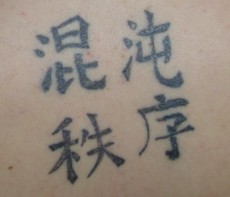
There's also chaos & order. The Chinese symbols on the left represent chaos & order. Most of my life has been represented by chaos. From family life and beyond, the lack of stability, and the lifetime of hurt. The last couple of years have been about tipping the scales and bringing order into chaos. I got the tattoo to remind me of the need for balance between chaos & order.

So however you want to look at it: good and evil, yin and yang, chaos and order, may you find peace.

Heather

Counter


View My Stats